
Milwaukee Art Museum
It's early afternoon in Milwaukee. I just finished buying spices at an indoor market. I had some great food while visiting family in the Midwest and wanted to bring a taste of it back home. My father-in-law excitedly told me about all the great food spots in the city. The man is a helluva chef, and I take his recommendations to heart. He's got one more must-see location before I unfortunately had to catch a flight back: the Bronze Fonz. We weaved past multiple bridges on the river until we found it. Its location was a little unassuming, but it was exactly as advertised. It was Bronze, and it was undoubtedly the Fonz. I struck a pose mimicking combing my hair like a greaser as my wife snapped a quick pic. Happy Days was a touch before my generation, but I've seen plenty of episodes, and I firmly believe that Henry Winkler is a national treasure.
Oh yeah, photography! So, I had another motive for visiting downtown Milwaukee unrelated to Mr. Winkler:
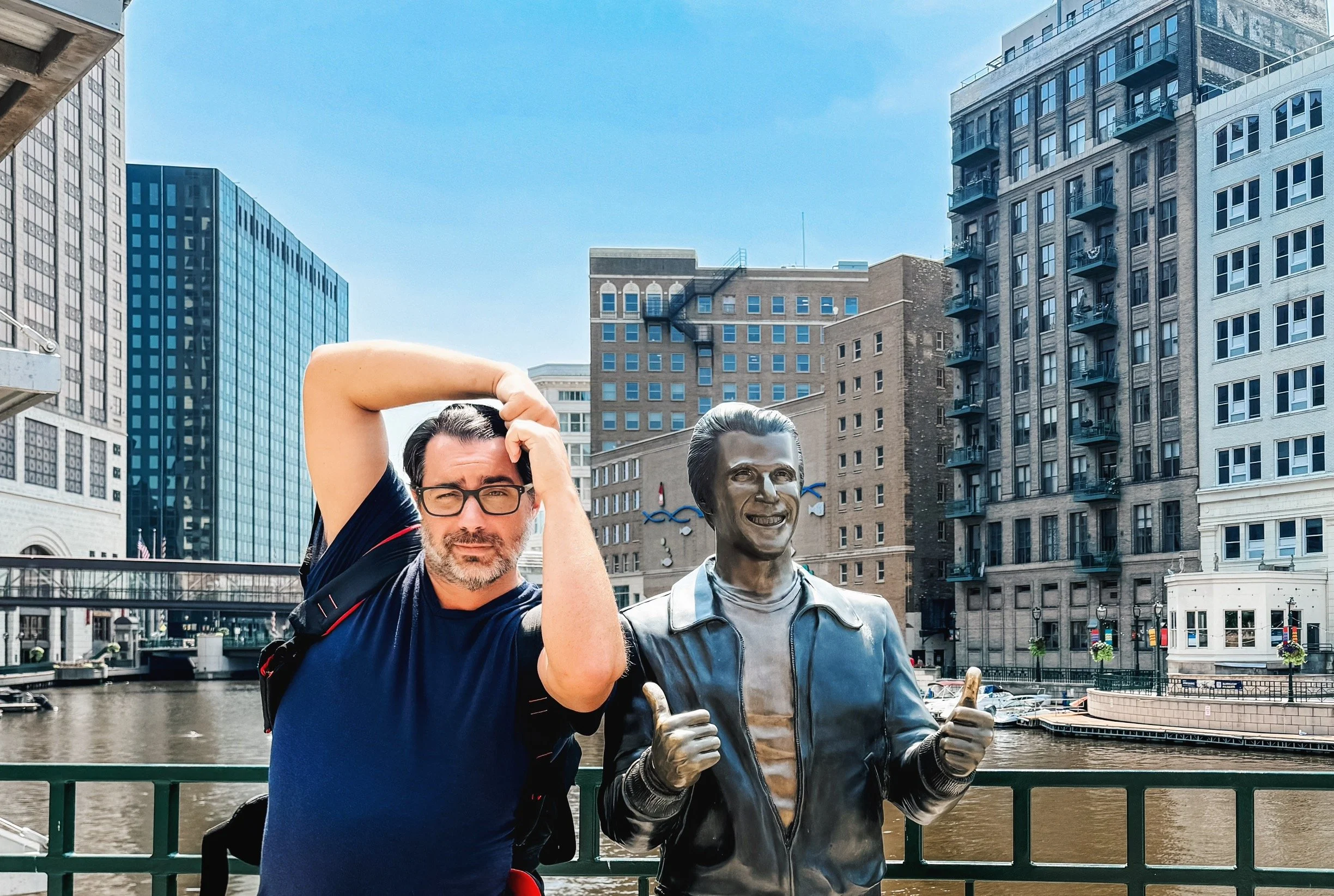
“Ayyyy.”
It was a bit larger, made of steel, and designed by Santiago Calatrava. I enjoyed visiting the Milwaukee Art Museum a few years back. I didn't have my camera gear at the time. I REALLY should have. It's a stunning design. It sits at the edge of Lake Michigan. The structure takes a bit to wrap your head around. It's low, flat, and elongated, with the end pulled to a graceful point over a park. The center mass rises to a semi-conical triangular shape. A pedestrian bridge with a tall mast and guy wires connects directly to a second-floor entrance. The building is painted in bright, BRIGHT histogram peaking white. The party piece, however, comes when the museum is open. Long, thin ribs that run the height of the center structure are mechanically lifted, creating the look of a sail catching wind. The center is revealed to be made of intricate glass, allowing a flood of light into the interior. It's gorgeous and captivating; as we pull up, it's closed. The sail I was on about sadly was down. It was a letdown, sure, but it was not something I had control over. This visit would be my only opportunity to photograph the building on the trip, and it was literally the last stop before the airport.
I hopped out of the car, simultaneously pulling the legs out on my travel tripod, and scoped out the scene. The sail was down, the time of day could have been better, and I only had a little time.
I could have scrapped it right there, saved some time, licked my wounds, and complained about how the universe had a vendetta against me. Or, I could give it the old college try and find a way to make it work. Since I had the benefit of visiting the building a few years back, I already knew what angles I wanted to get. Making my way through the park, I pointed the camera towards the point on the south end of the building. A slight drawback is a recessed loading door that sits below the point. It's not distracting, and a curved driveway provides a half-decent leading line. The tradeoff is an incredible view of the geometry of the building. Blur your eyes a bit, and you will have a white Rorschach ink blot made of ship elements. Saying it stands out compared to other buildings in the city would be an understatement. It's wild yet absolutely fitting. I'm operating at shutter speeds faster than I'm used to for this kind of work, compensating for a bright sky and dramatically brighter building. Oof, that white paint. If my camera could talk, it would be too busy laughing at the histogram. I don't want to close down the aperture further than I already have, but I give in a little and finally land at my preferred exposure. A few clicks later, the first shot is done.
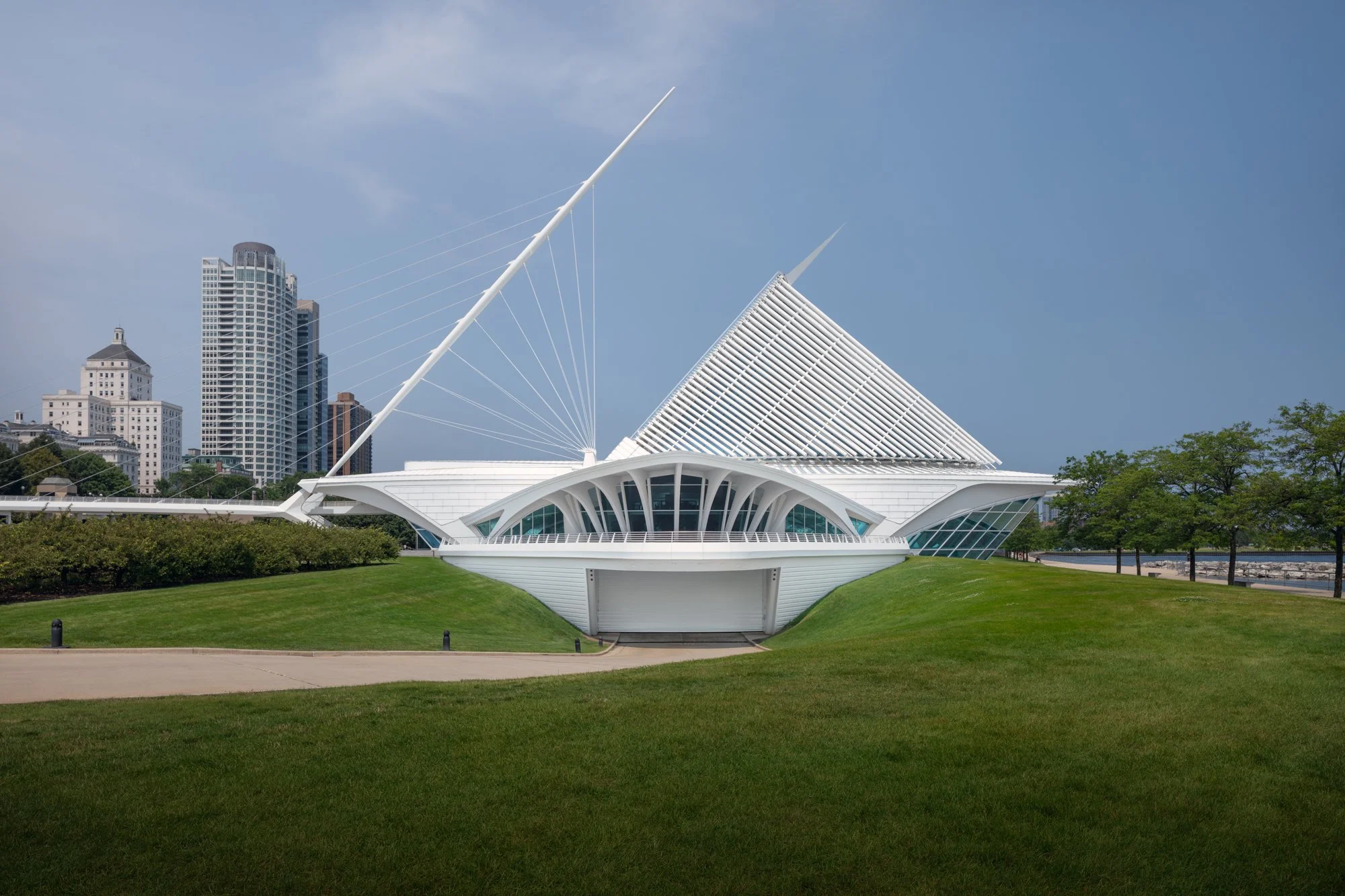
The building has excellent sight lines around most of it with few obstructions. As a result, it's easy to take a good pic of the building, even with your phone. I already knew the spot to set up. I proceed across the driveway, the camera gets placed southeast of the entry facade. It's a good composition by default, but I can't shake the feeling of being too wide. Picking up the camera, I push in a bit. Still not happy, but better. I start slowly shuffling south, adding more dimension to the point at the far end. This movement helped to minimize a Corten steel sculpture near the front of the building. I've got a love/hate relationship with Corten Steelwork. Usually, I wouldn't say I like it when hung on a building facade or sculpture slapped in front of a business park. I feel the style will age similar to Edison bulbs and granite countertops. However, a brilliant application of this concept is the sculpture "Wake" by Richard Serra in Seattle's Olympic Sculpture Park. Art is subjective, of course. But seriously, check out the Olympic Sculpture Park. It's incredible! The sculpture in front of the Art Museum was not bad; it was a visual distraction from the building lines. The further south I shifted, the less intrusive it became, and I found an angle with which I was happy. I ran a 9-frame bracket in case I needed the extra dynamic range to pull into the final composite. The high-contrast scene would make for a challenging edit. I waited for a few people to wander into the scene to add some life. This was helped by an Uber dropping off soon-to-be disappointed visitors.
I capped off the second shot with a slow shutter of a cyclist whizzing by.

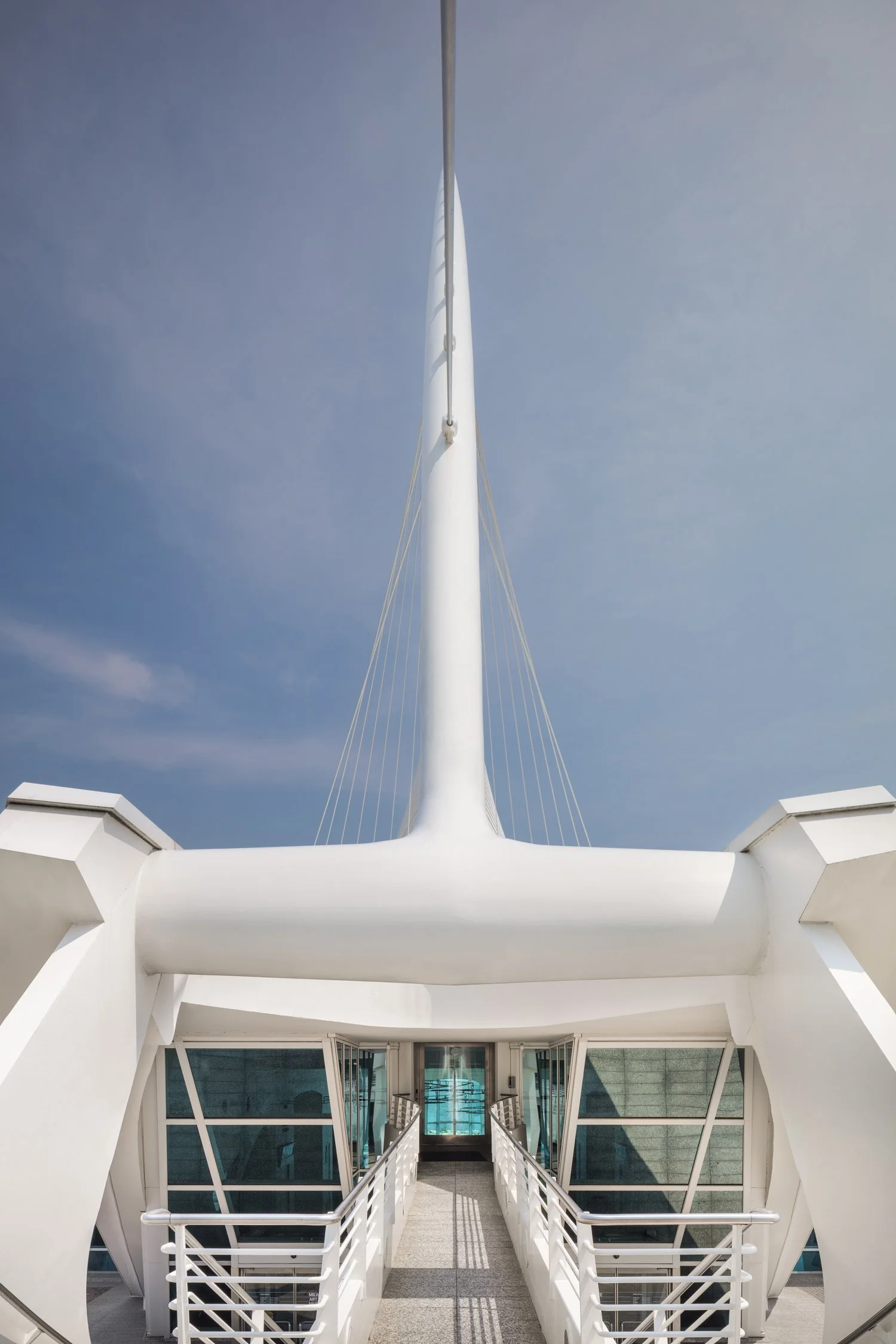
Mindful of the quickly dwindling time, the hassles of rushing through TSA entered my mind. There are a couple more pictures I'd like to try. I hustle up the pedestrian bridge and set up at the far end of the guy wires running from the mast. I like the symmetry, but the scene is too minimal. This would have worked if the sail had been up, but oh well. I pick up, move forward, and take a minimalist shot underneath the guy lines. This is close to the second-floor entrance, but the shot looks interesting.
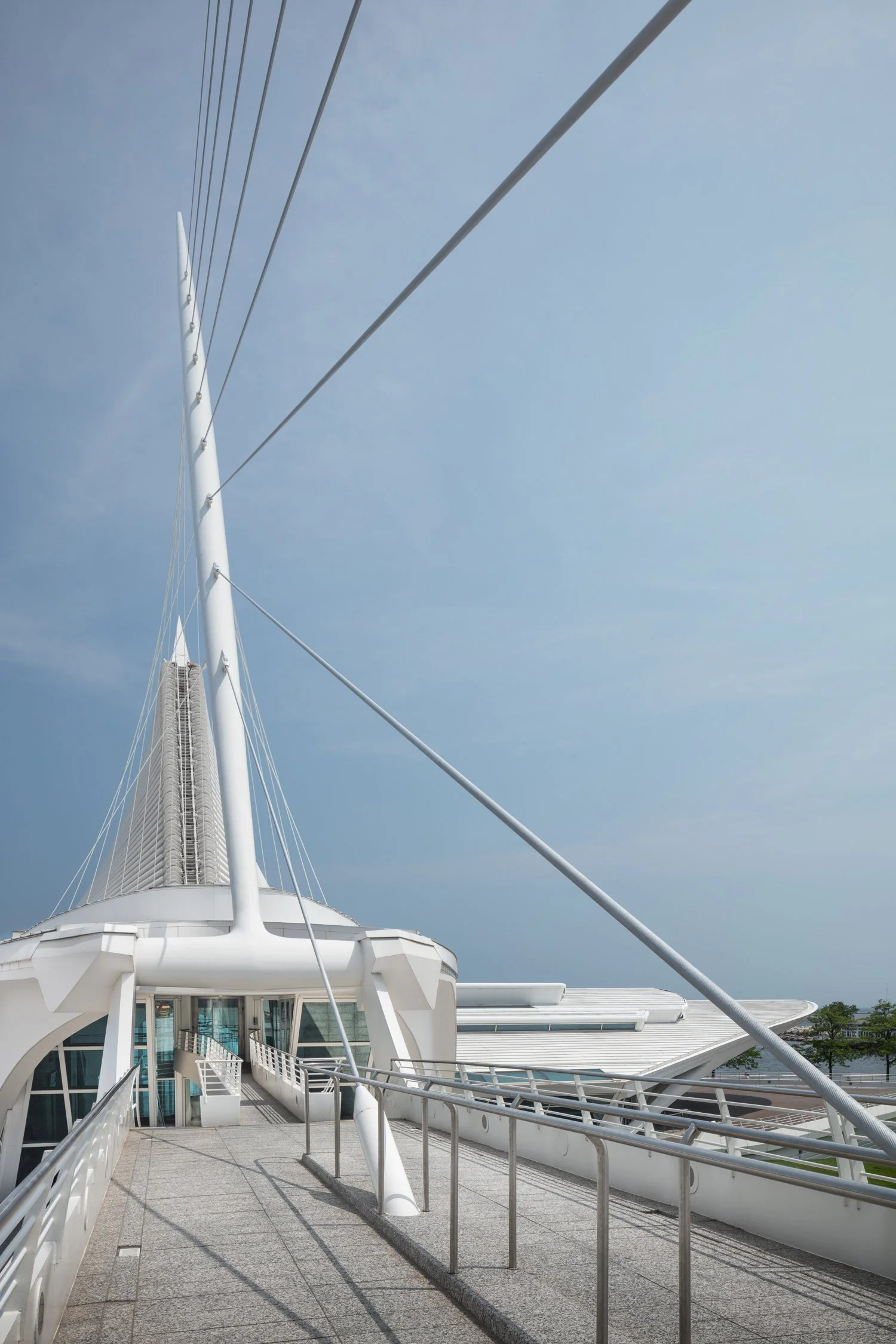
I should wrap it up here. I can't shake the desire to get a shot focusing more on the guy lines. The tripod and camera are pushed back and offset to the left. The lens gets shifted up a quarter of the way, and I find the elusive composition. The lines look like they're firing from multiple angles, drawing the eye to the mast and then down to the structure.
With that wrapped, I was off to the airport, reviewing the shots as we pulled into the terminal drop-off area.
Like the Corten steel bit, editing is entirely subjective. However, for high-contrast scenes, luminosity masks are a near-essential tool for rescuing shadows and highlights.
So, lessons? Don't give up and pack things in if the situation isn't ideal. I've been on plenty of photoshoots that initially look like it won't work. Find something that does and drill down into it. If the lighting blows, look at how the light is falling and see if a dynamic shadow is being cast somewhere. If the subject is flat, move till you find some dimension. If there's a distraction, find a way to minimize it. If the sail isn't up, it's still one heck of a sculpture. Get capturing and you may just come away with something unexpected.